
Birthing Livestock
If you are on this page, you are probably equal parts excited and nervous for what’s in store, and that’s exactly where you want to be! The arrival of a new life on the farm is always a special moment; however, there can also arise some challenges. Knowing how to prepare and care for your animals during labor and delivery is crucial for the well-being of both mom and baby. So pull on your boots, top off your coffee, and get ready for one of the most rewarding and unforgettable experiences you will have on your homestead.
WHAT TO DO BEFOREHAND
Create a Safe Space to Give Birth
For cows, this can be a fenced, grassy field. You want the area to be up close so you can keep an eye out for any potential problems.
For goats and sheep, you want a quiet, warm, clean space with good ventilation. It doesn’t need to be fancy. It can be a penned-off area in your barn or a spot in your garage. What is important is that it is clean and private so mom and babies can be healthy, safe, and comfortable. When you start to see your goat or sheep showing signs of impending labor (see below), you will want to place them in this pen, away from your other animals, so they can comfortably and safely give birth and raise their babies.
Make a Birthing Kit

Chlorhexidine 2% Solution
Can be purchased at most livestock supply stores
Most of the time, animals are able to give birth without any intervention; however, there are a few things you will want to have on hand so that you are prepared if assistance is needed.
Clean Towels - to clean off babies
Gloves - to keep clean and prevent transmission of potential disease to you
Sterile Lubricant - in case you need to assist with positioning the baby
Colostrum & Milk Replacer - species-specific is best, just in case you need to bottle raise (see below)
Thermometer - you can use a normal human thermometer to take a rectal temperature of mom or babies, just mark it so it doesn’t make its way back into the house (gross)
Bulb Syringe - for clearing the nose and mouth of babies
2% Chlorhexidine Solution – dilute in a small cup 1 part 2% Chlorhexidine to 4 parts clean water. This can be used to dip the umbilicus if desired.
Karo Syrup - to put in mom’s water post birth or to rub on baby’s gums if they are weak.
SIGNS OF IMPENDING LABOR
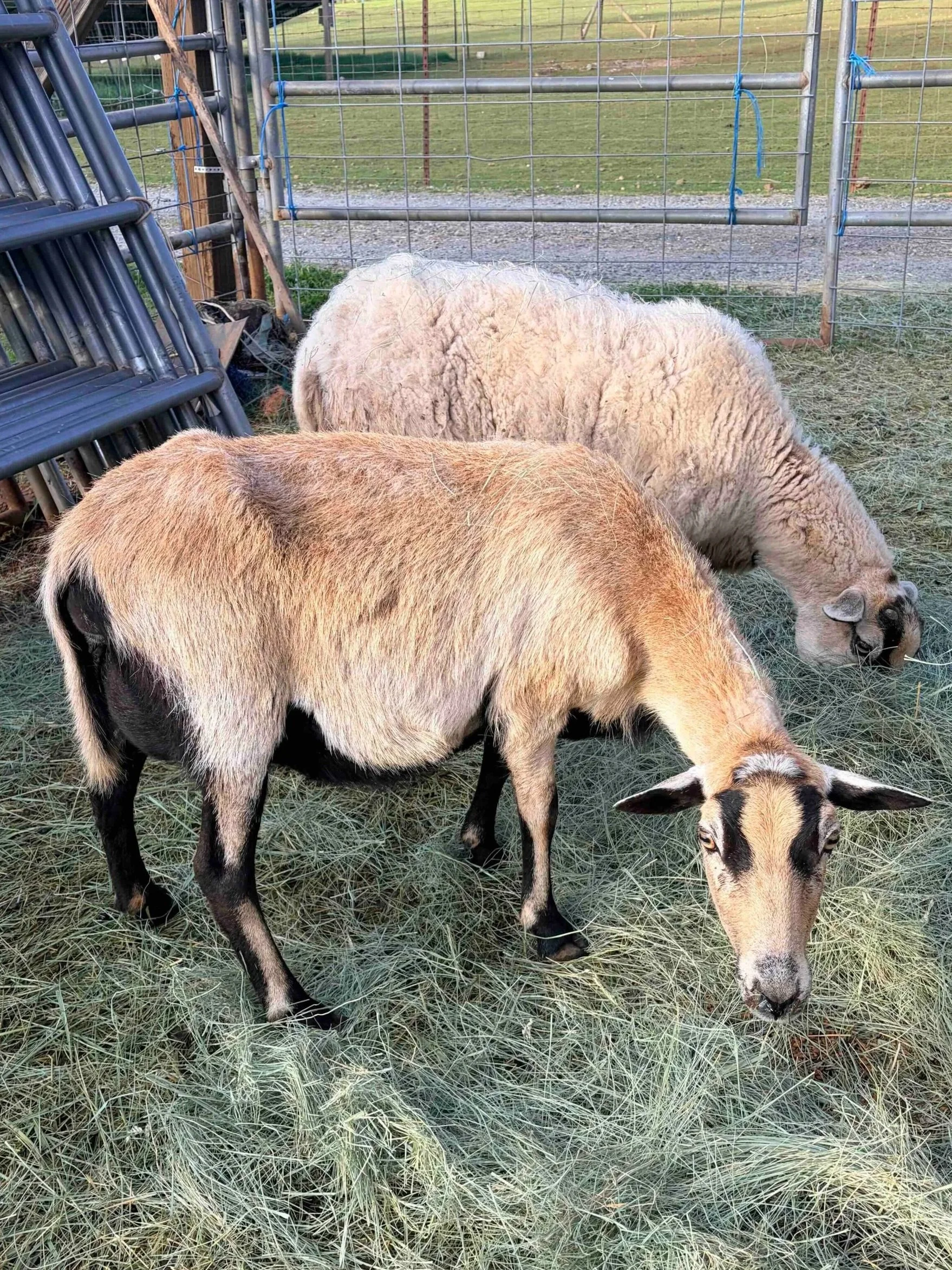
Relaxed ligaments and swollen udder in a sheep about to give birth
Image courtesy of Gold Ridge patient records
Nesting - She may begin to seek out a quiet, private place. She might become restless and start pacing, looking for a place to settle.
Restlessness - She may seem agitated or uncomfortable. She might lie down and get up repeatedly, trying to find a comfortable position.
Swollen Udder - Her udder will become noticeably larger and firmer as it fills with milk. Her udder will develop about 30 days before giving birth, and the cistern (tip of the udder) will fill with colostrum a few days before birthing.
Relaxed Pelvic Ligaments - The ligaments around the tail area (known as the “tail ligaments”) will soften and become more relaxed. This causes the tail to droop and dimples to appear on either side of her rump near the tail base. See photo.
Mucus Discharge - You may notice a clear or slightly bloody mucus discharge from her vulva. This is a sign that the cervix is starting to open in preparation for birth.
Changes in Appetite - She may lose their appetite or stop eating much as they near labor. Others might eat more, so this can vary.
Behavioral Changes - She might be more vocal, bleating more frequently, or she might become more affectionate, seeking your attention.
Pushing or Straining - In the final stages, you may notice the goat starting to push or strain. This is often when actual delivery is imminent.
SIGNS THAT INTERVENTION IS NEEDED

Normal progression. Visible amniotic sac of 3rd kid.
Image courtesey of Gold Ridge patient records
If you see any of the events outlined below or have any other concerns, please seek veterinary advice and attention immediately. Early intervention is essential for a good outcome.
Prolonged Labor (more than 2 hours)
Labor should be short (less than 4 hours for a cow – most give birth within an hour and less than 2 hours total labor for sheep/goats). If the labor is prolonged (see the animal straining for more than 20 minutes without progression), this may indicate that the baby is positioned incorrectly or there are other complications.
Straining Without Progress
Your animal may push or strain without making progress. This could suggest an issue such as the baby being too big for the mom (especially in your first-time, young moms), the baby is positioned incorrectly, too exhausted to push, or low electrolytes. If no progress is seen after 20 minutes, intervention is most likely needed.
Abnormal Presentation of the Baby

Head first, no legs visible. May require assistance.
Image courtesy of Gold Ridge patient records
Calves should present two front legs and head first. Lambs and kids can normally present both with their two front legs and head first or their two back legs first. Butt/tail first is abnormal in all species and requires intervention.
Excessive Discharge
A small amount of clear mucus discharge is normal, but excessive blood, green or brown discharge, or foul-smelling discharge can indicate there is a problem like fetal distress, infection, or the placenta detaching prematurely.
Excessive Restlessness or Distress
While animals are generally restless during labor - constantly pacing, sweating, or acting anxious without progress can be a sign that something isn’t right. Also, if you see signs of pain, such as vocalizing – this can indicate the birth is not going smoothly.
Visible Baby Parts with No Progress
If you can see any part of the baby protruding and there’s no further progression despite the animal straining after 20 minutes, this could mean the baby is stuck in the birth canal.
Failure of the Animal to Begin Labor
If your animal has not given birth past their suspected due date, this could be an indication that she has a problem, such as a uterine infection, failure of the cervix to dilate, or deceased babies. You should seek veterinary attention.
HOW TO ASSIST
More severe labor complications need veterinary assistance, but if you are comfortable, there are many interventions you can do to help ensure a good outcome if assistance is needed. Again, when a problem arises, early intervention is key to a good outcome, and a vet can be an hour or more away. Being comfortable with basic assistance techniques can help prevent a complication from turning into a disaster.
Closely Monitor
You aren’t going to catch a complication unless you are watching. Closely monitor when the first signs of labor are seen. It might be best to reach out to your local veterinarian during this time to notify them that labor has started, so they have you on their radar in case intervention is needed.
Assist with the Birth if Necessary
If you are comfortable, you can attempt to reposition or pull babies that appear to be in distress. Use gloves (to prevent contamination and infection to both the animals and yourself) and lots of sterile lube. Do not pull hard! If you have to pull hard, then something is wrong. Pulling hard can cause severe injury to both baby and mom and may result in the death of one or both. If you are unsure or uncomfortable, then wait for veterinary assistance.
Assist with Breathing if Necessary

Bulb Syringe
Can be purchased online or many feed stores or pharmacies
If the babies appear to be having trouble breathing (excessive coughing, not breathing), place them on their stomach with all four legs pulled forward (the best position for opening up their lungs), and vigorously rub their back with a dry towel. Tickle the inside of their nostrils with a small piece of straw to stimulate the breathing reflex and get them to take a deep breath. You can also clear their mouth and nose with a bulb syringe. Never swing or hang babies!!
Dip Umbilicus if you Desire
There are many umbilical dip strategies out there; however, current evidence-based research has shown that no intervention is better than dipping with iodine or alcohol, which are way too caustic. If the umbilicus is dirty and you wish to dip the best solution is 2% Chlorhexidine diluted 1 part to 4 parts clean water.
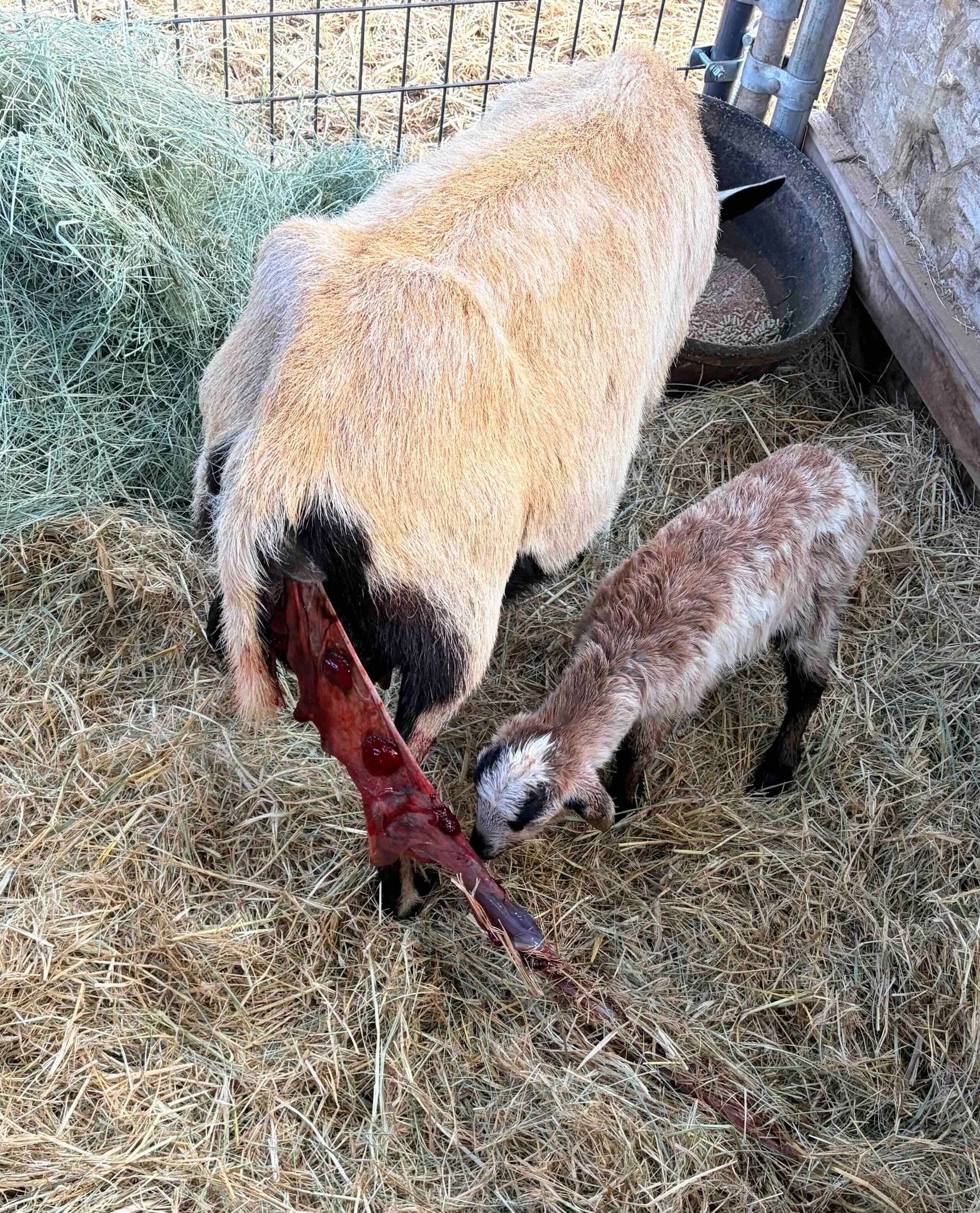
Normal placenta delivery
Image courtesy of Gold Ridge patient records
Watch for the Passage of the Placenta
After all the babies are delivered, the mom should pass her placenta within the next 12 hours. The placenta will look red and velvety compared to the white, glistening amniotic sac that the babies were in. Do not pull on the placenta, let it fall naturally on its own. Pulling on the placenta can lead to tearing and retained pieces.
A retained placenta can be life-threatening. Please monitor for passage of the placenta, which should happen within 12 hours for sheep, goats, and cattle. If they do not pass the placenta or the mom is showing signs of illness (off feed, lethargic), please seek veterinary care.
Get Mom Some Food!
The excitement of the new babies can make people forget about mom. She is most likely exhausted and famished. Provide her with some good-quality hay and warm water flavored with molasses or Karo syrup. She deserves it!
WHAT NOT TO DO
Do Not Excessively Pull
If you try to assist in repositioning or pulling a baby that appears in distress, do not pull aggressively. This can lead to limb and spinal cord injuries and potentially death to the baby or mom. If you cannot remove the baby without excessive force, or you are not comfortable aiding in the birth, please wait for veterinary assistance.
Do Not Swing Babies
It is a long-standing myth that swinging or hanging babies can help “clear their lungs.” What is actually happening is the fluid from their stomach is coming out of their mouth, and this can lead to aspiration pneumonia and severe complications. If your baby is having trouble breathing place them on their stomach with legs pulled forward, rub vigorously with a dry towel, and stimulate their nostrils with a piece of straw. You can also clear their mouth and nose with a bulb syringe.
Do Not Cut Umbilical Cords
It is best to let the cords pull and break naturally. Cutting them can cause complications, including excessive bleeding and infection. Even the long cords will shrivel up in the next 2-3 days.
WHEN TO BE CONCERNED POST BIRTH
Mom Continues to Push
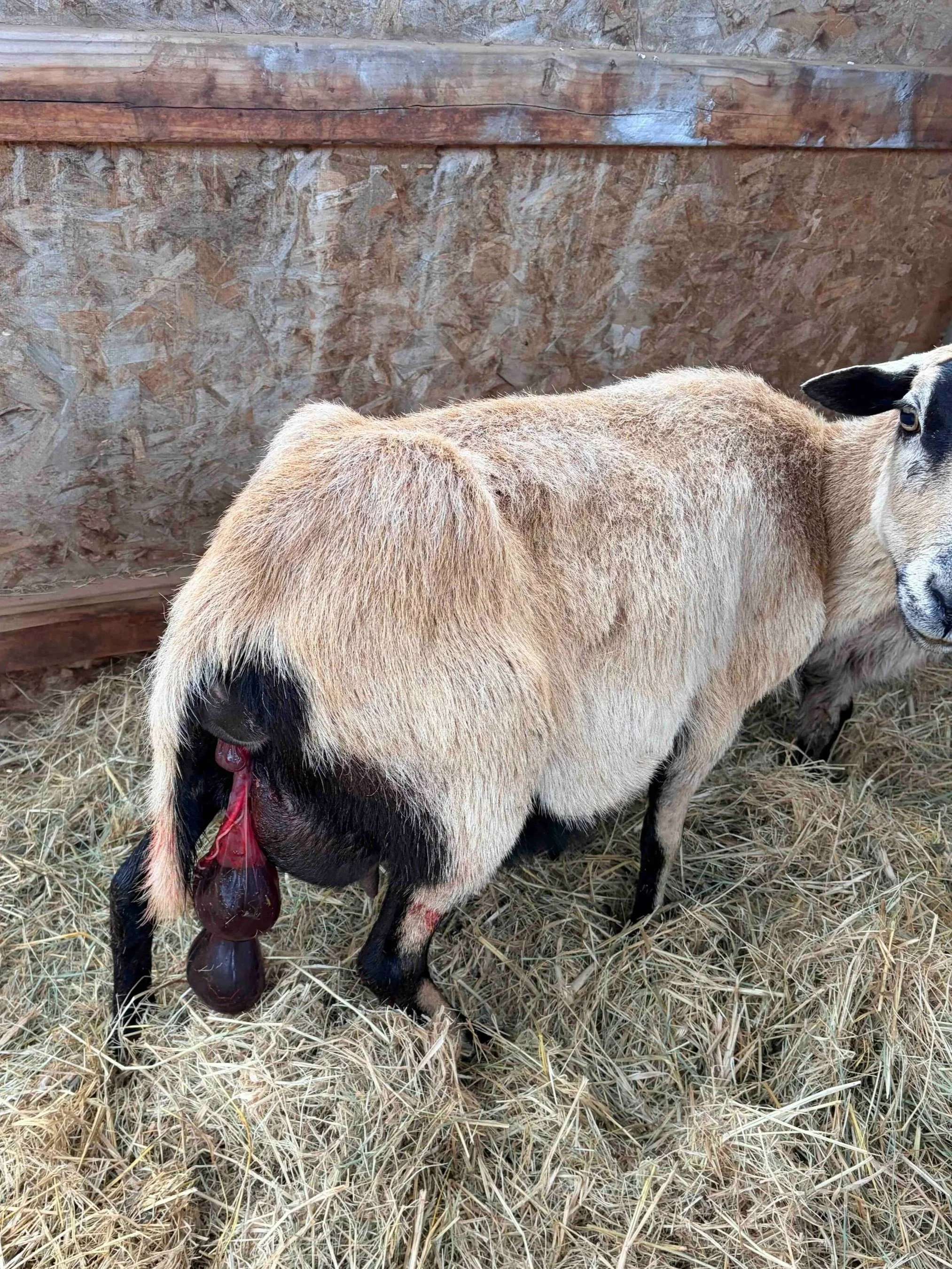
Double Placenta
Image courtesy of Gold Ridge patient records
If mom is continuing to push, vocalize, lie on her side, or appear restless, this is an indication that there is something wrong. She could have another baby to birth, a retained placenta, or severe vaginal or uterine tears. Also, remember that goats and sheep can have two placentas, so even if the placenta has passed, there still could be another fetus if she is continuing to push and appear uncomfortable. Please seek veterinary attention immediately.
The Baby Isn’t Meeting Benchmarks
Babies should stand within the first hour and nurse within the first 1-2 hours. If they are delayed, this could be an indication that there is something wrong with them developmentally that may require veterinary attention.
Mom’s Sick
Closely watch mom for the next few days to ensure she recovers well from the birthing process. If she seems quiet, off feed, has painful or discolored udders, or is febrile (rectal temperature over 103.5°F), please seek veterinary attention immediately.
BOTTLE FEEDING
Now that the birth is done, here comes the hard part: raising these little creatures. Moms will reject babies for a variety of reasons - she’s too young or inexperienced, she gets sick, has an udder infection, she has multiples (they will typically only choose two to raise), or she plain doesn’t want them.
If you have an orphaned baby, you can choose to bottle-raise it. Don’t bottle-feed unless it is absolutely necessary. Bottle feeding can lead to a variety of medical and behavioral problems, so it is best to give mom a chance to raise them first before intervening. Bottle raising should be a last resort.
What to Feed
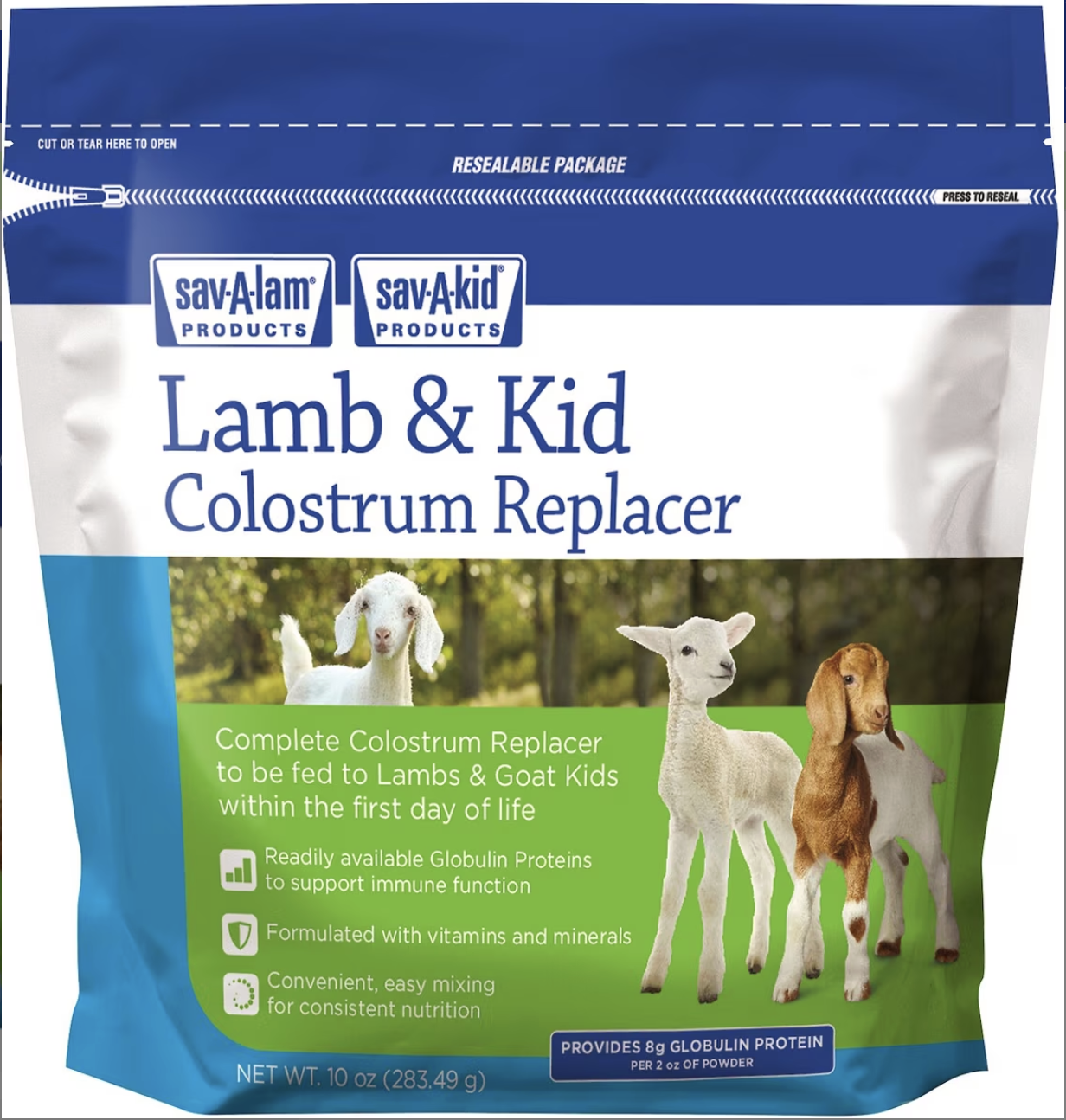
Colostrum Replacer
Available at most feed stores
In the first 18-24 hours after birth, babies have what is called an “open gut.” Their gastrointestinal tract allows more things to be absorbed by the body during this time, and this is how they are able to absorb colostrum (the antibody-rich first lactation from their mom). The baby must receive about 15% of their body weight in colostrum within the first 18-24 hours (about 12 oz of colostrum for a 5 lb baby). Failure to reach this benchmark can lead to a life-threatening condition called “Failure of Passive Transfer,” where the baby becomes immunocompromised and more susceptible to infection. Also keep in mind that during the first 18-24 hours, the baby’s gut is open to everything, not just colostrum. Any dirt, bacteria, or feces they ingest also has a direct highway into their body. This is why it is very important to keep your birthing area clean.
Your options for colostrum include their mom (milk her out and bottle feed directly to the baby), colostrum replacer (NOT supplement, designed specifically for the species is best), or saved colostrum that was previously frozen (if you had a mom that birthed but didn’t raise her baby you can milk her out and freeze the colostrum for later use).
After the 24-hour mark, you can start to transition to milk. If you still have colostrum left over, continue to feed it. Colostrum is still nutrient-dense, but they will no longer be absorbing the antibodies. Once the colostrum is gone, you can start feeding milk. Options for milk include the mom, milk from another mom (same species), or milk replacer (milk replacer designed specifically for the species).
How Much to Feed
Orphaned babies are usually weaker and require special and more delicate care compared to their parented counterparts. This means that initially, they require frequent, tiny meals to ensure they absorb nutrients, keep their glucose levels up, and prevent serious complications from over-eating (like “rumen drinking” or bloat). As your baby gets stronger, you can increase the amount they receive each meal and lower the number of feedings per day.
Initially (first week of life), you want to aim to feed them about 15% of their body weight a day (about 12 oz per 5 lbs). This should be divided up into feedings every 2 hours (so 12 feedings per day - 1 oz per feeding). Yes, this will require you to get up in the middle of the night and feed them. Young babies’ glucose storages are very small, and they are very susceptible to hypoglycemia (low blood sugar). Not feeding them overnight can cause them to become hypoglycemic, resulting in severe weakness, inability to nurse, and death.
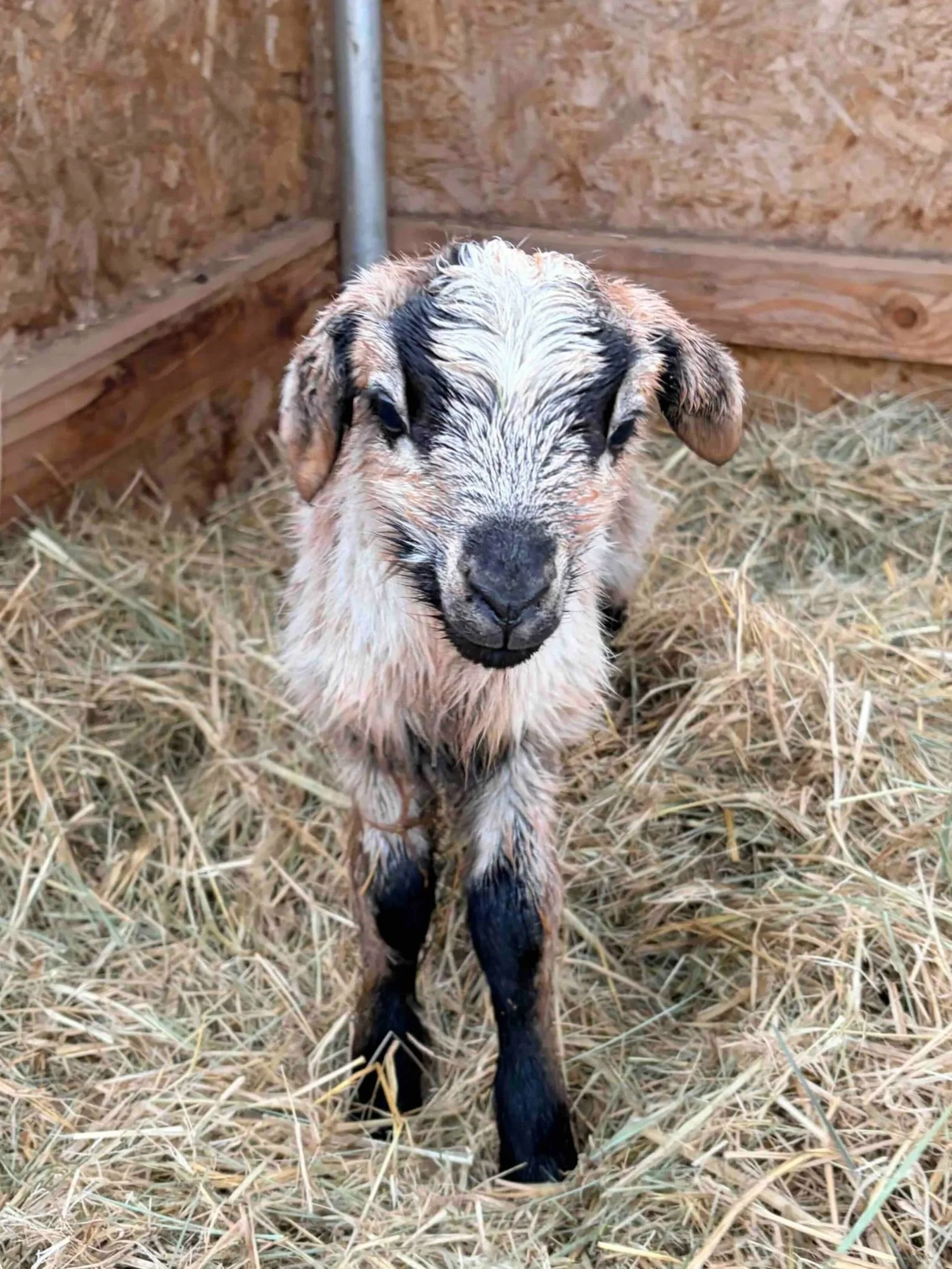
Weigh your baby every day (you can use a food scale for very small babies or a regular scale - weigh yourself and baby, then weigh yourself solo and subtract to get the baby’s weight), and adjust their amount per feeding to reach the 15% body weight.
How to do feeding calculations:
Take your baby’s weight in pounds (for example, 8 pounds) and multiply that by 0.15 (15%). Then take this amount and multiply it by 16 (for 16 ounces in a pound). This gets you the total ounces per day.
So an 8 pound baby x 0.15 x 16 = 19.2 ounces per day.
Next, divide that amount by the total number of feedings (initially 12, but then you will drop that down every week). So for the first week, this is about 1.5-2 ounces per feeding for an 8-pound baby.
It is very important not to overfeed your baby. Measure out the goal amount of ounces per feeding and put that in the bottle to ensure you don’t overfeed. Your baby might still be hungry after eating. That is okay! Initially, you do not want to go over this feeding amount because it can lead to serious life-threatening digestive complications, including “rumen drinking” and bloat. Remember, if they were still on mom, they would be eating multiple times a day and only a little at a time. You are trying to replicate that!
After the first week, if your baby is nursing well, strong, and gaining weight, you can start to lower the frequency of feedings and increase the total amount. You can start feeding up to 20% body weight per day (be careful not to go over this, though), and lower their feedings to 8 times a day, then next week 6 times, then 4 times, and so on. Re-weigh your baby frequently and adjust the feeding amounts accordingly:
Example: 15 lb baby receiving 20% body weight in milk 6 feedings a day - 15 x 0.2 x 16 / 6 = 8 oz per feeding

Lamb/Kid Bottle
Available at most feed stores.
How to Bottle Feed
First ensure they have a strong suckle. Stick a clean finger or gloved hand into their mouth to test their suckle reflex. If there is no suckle reflex present, then your baby is too weak to nurse and requires veterinary assistance. Force feeding, syringe feeding, or tube feeding a baby without a suckle can lead to severe, life-threatening complications like bloat and rumen drinking.
If there is a strong suckle, proceed with bottle feeding. It is easiest to control the baby and the bottle by crouching behind the baby and placing the bottle in front of them. Standing in front of them and offering the bottle can decrease control and lead to difficulties latching and aspiration.
Be careful not to let the baby’s head go too high. You want their nose to be parallel to the ground. Allowing them to pull their nose upward can cause them to drink too fast and may lead to aspiration pneumonia or bloat.
What Bottle & Nipple to Use
You want a bottle and nipple that is the appropriate size for your baby. Baby bottles, or soft red livestock nipples, tend to work best for lambs and kids. Calves usually tolerate the big calf bottles well. Make sure the nipple is open but not too open (the red livestock nipples usually need to be cut), and that it is dripping out of the nipple, not pouring out when held upside down. Nipples that are too open can cause the baby to suck too fast, and they may aspirate into their lungs.
My baby won’t take the bottle!
Bottles are very foreign to babies; they don’t smell like mom, feel like mom, and aren’t warm like mom. If your baby is having trouble with the bottle, this is common! Don’t be discouraged, keep trying, but don’t force the baby. Forcing them to drink or tube/syringe feeding them can lead to serious complications like aspiration pneumonia and bloat.

Things to try if your baby is having trouble:
Change the nipple. There are several options out there, and every baby has a preference.
Warm the nipple under warm water before feeding.
Try blindfolding or covering the baby's eyes when feeding.
Scratch their back to encourage them.
Ensure you are feeding warm milk or milk supplement. Cold can lead to digestive issues.
When the nipple is in their mouth, rock their lower jaw back and forth
Ensure they have a suckle - stick a clean finger or gloved hand into their mouth. If they do not have a suckle, they are too weak to nurse and require veterinary assistance.
KEY TAKEAWAYS
And there you have it! You’ve made it through the miracle and mess of new life. There will be surprises, a little chaos, and lots and lots of laundry, but with a little preparation and patience, you've got this! Here’s to healthy mamas, bouncy babies, and the bragging rights of a successful birthing season!
References
D.G. Pugh, P. (2002). Sheep & Goat Medicine. Saunders.
Stuttgen, W. by S. (n.d.). Three stages of bovine parturition. Livestock. https://livestock.extension.wisc.edu/articles/three-stages-of-bovine-parturition/
Zimmerman, J. J. (2019). Diseases of swine. John Wiley & Sons, Inc.
Related Resources
https://www.extension.purdue.edu/extmedia/VA/VA-30-W.pdf
https://extension.illinois.edu/blogs/cattle-connection/2023-02-03-stages-parturition
